


Assyrian ca. 883–859 BCE
From the ninth to the seventh century B.C., the kings of Assyria ruled over a vast empire centred in northern Iraq. The great Assyrian king Ashurnasirpal II (r. 883–859 B.C.), undertook a vast building program at Nimrud, ancient Kalhu. Until it became the capital city under Ashurnasirpal, Nimrud had been no more than a provincial town. The new capital occupied an area of about nine hundred acres, around which Ashurnasirpal constructed a mudbrick wall that was 120 feet thick, 42 feet high, and five miles long. In the southwest corner of this enclosure was the acropolis, where the temples, palaces, and administrative offices of the empire were located. In 879 B.C. Ashurnasirpal held a festival for 69,574 people to celebrate the construction of the new capital, and the event was documented by an inscription that read: “the happy people of all the lands together with the people of Kalhu—for ten days I feasted, wined, bathed, and honored them and sent them back to their home in peace and joy.”
The so-called Standard Inscription that ran across the surface of most of the reliefs described Ashurnasirpal’s palace: “I built thereon (a palace with) halls of cedar, cypress, juniper, boxwood, teak, terebinth, and tamarisk as my royal dwelling and for the enduring leisure life of my lordship.” The inscription continues: “Beasts of the mountains and the seas, which I had fashioned out of white limestone and alabaster, I had set up in its gates. I made it (the palace) fittingly imposing.” Among such stone beasts is the human-headed, winged bull pictured here. The horned cap attests to its divinity, and the belt signifies its power. The sculptor gave these guardian figures five legs so that they appear to be standing firmly when viewed from the front
but striding forward when seen from the side. Lamassu protected and supported important doorways in Assyrian palaces.
Ezekiel 1 – King James Version
- 1 Now it came to pass in the thirtieth year, in the fourth month, in the fifth day of the month, as I was among the captives by the river of Chebar, that the heavens were opened, and I saw visions of God.
- 2 In the fifth day of the month, which was the fifth year of king Jehoiachin’s captivity,
- 3 The word of the Lord came expressly unto Ezekiel the priest, the son of Buzi, in the land of the Chaldeans by the river Chebar; and the hand of the Lord was there upon him.
- 4 And I looked, and behold, a whirlwind came out of the north, a great cloud, and a fire enfolding itself, and a brightness was about it, and out of the midst thereof as the colour of amber, out of the midst of the fire.
- 5 Also out of the midst thereof came the likeness of four living creatures. And this was their appearance; they had the likeness of a man.
- 6 And everyone had four faces, and everyone had four wings.
- 7 And their feet were straight feet; and the sole of their feet was like the sole of a calf’s foot: and they sparkled like the colour of burnished brass.
- 8 And they had the hands of a man under their wings on their four sides; and they four had their faces and their wings.
- 9 Their wings were joined one to another; they turned not when they went; they went every one straight forward.
- 10 As for the likeness of their faces, they four had the face of a man, and the face of a lion, on the right side: and they four had the face of an ox on the left side; they four also had the face of an eagle.
- 11 Thus were their faces: and their wings were stretched upward; two wings of every one were joined one to another, and two covered their bodies.
- 12 And they went every one straight forward: whither the spirit was to go, they went; and they turned not when they went.
- 13 As for the likeness of the living creatures, their appearance was like burning coals of fire, and like the appearance of lamps: it went up and down among the living creatures; and the fire was bright, and out of the fire went forth lightning.
- 14 And the living creatures ran and returned as the appearance of a flash of lightning.
- 15 Now as I beheld the living creatures, behold one wheel upon the earth by the living creatures, with his four faces.
- 16 The appearance of the wheels and their work was like unto the colour of a beryl: and they four had one likeness: and their appearance and their work was as it were a wheel in the middle of a wheel.
- 17 When they went, they went upon their four sides: and they turned not when they went.
- 18 As for their rings, they were so high that they were dreadful; and their rings were full of eyes round about them four.
- 19 And when the living creatures went, the wheels went by them: and when the living creatures were lifted up from the earth, the wheels were lifted up.
- 20 Whithersoever the spirit was to go, they went, thither was their spirit to go; and the wheels were lifted up over against them: for the spirit of the living creature was in the wheels.
- 21 When those went, these went; and when those stood, these stood; and when those were lifted up from the earth, the wheels were lifted up over against them: for the spirit of the living creature was in the wheels.
- 22 And the likeness of the firmament upon the heads of the living creature was as the colour of the terrible crystal, stretched forth over their heads above.
- 23 And under the firmament were their wings straight, the one toward the other: everyone had two, which covered on this side, and everyone had two, which covered on that side, their bodies.
- 24 And when they went, I heard the noise of their wings, like the noise of great waters, as the voice of the Almighty, the voice of speech, as the noise of an host: when they stood, they let down their wings.
- 25 And there was a voice from the firmament that was over their heads, when they stood, and had let down their wings.
- 26 And above the firmament that was over their heads was the likeness of a throne, as the appearance of a sapphire stone: and upon the likeness of the throne was the likeness as the appearance of a man above upon it.
- 27 And I saw as the colour of amber, as the appearance of fire round about within it, from the appearance of his loins even upward, and from the appearance of his loins even downward, I saw as it were the appearance of fire, and it had brightness round about.
- 28 As the appearance of the bow that is in the cloud in the day of rain, so was the appearance of the brightness round about. This was the appearance of the likeness of the glory of the Lord. And when I saw it, I fell upon my face, and I heard a voice of one that spake.
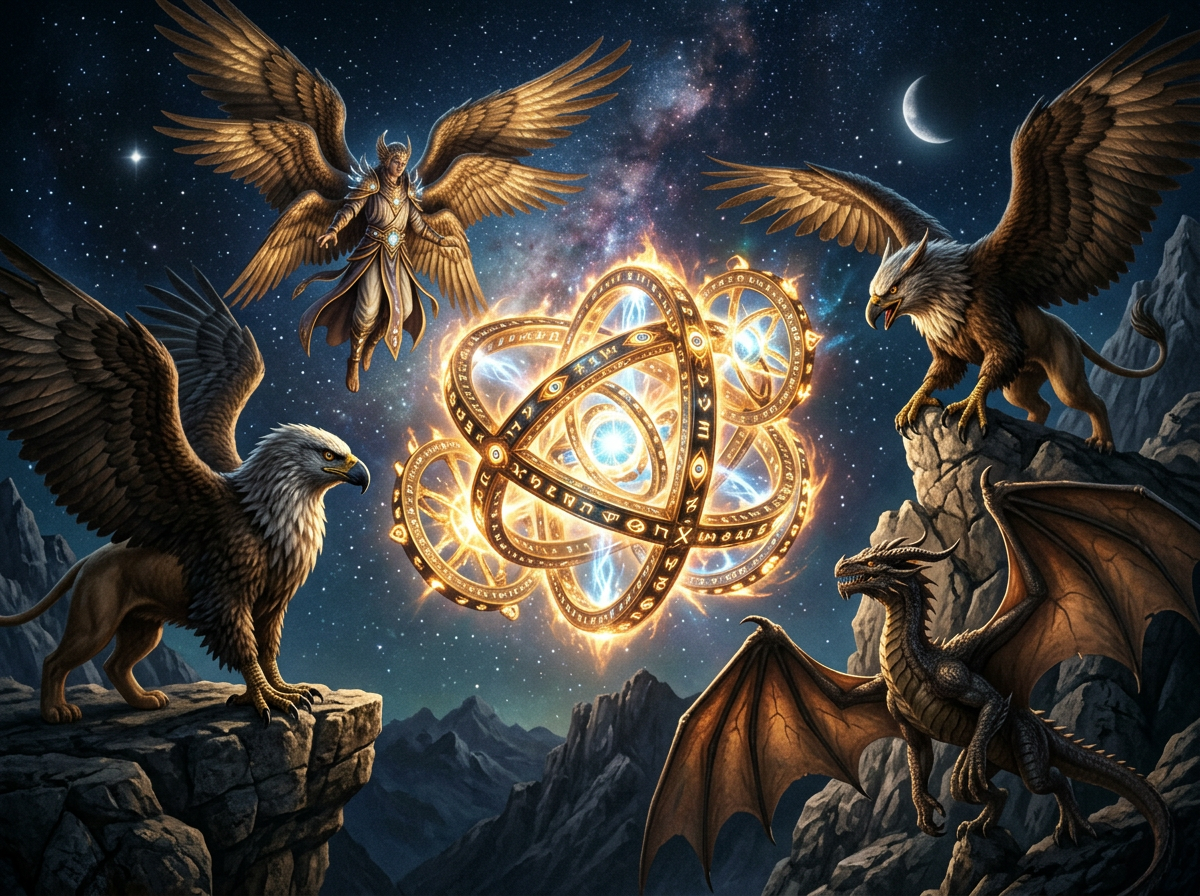
- The Order of The Four Horsemen Zodiac Houses – Revelation Chapter 6
- The face of a Lion, on the right side: Leo – The Sun – White Horse – South – Conquest
- The face of an Eagle: Scorpion – Mars – Red Horse – West – War
- The face of a Man: Aquarius – Saturn – Black Horse – North – Famine
- The face of an Ox on the left side: Taurus – Venus – Pale Horse – East – Death
- Western Houses: Virgo – Libra – Scorpio – Autumn (Mars) – White
- Southern House: Gemini – Cancer – Leo – Summer (Sun) – Red
- Eastern Houses: Pisces – Aries – Taurus – Spring (Venus) – Blue
- Northern Houses: Sagittarius – Capricorn – Aquarius – Winter (Saturn) – Black
Śukadeva Gosvāmī continued; My dear King, as stated before, the learned say that the sun travels over all sides of Mānasottara Mountain in a circle whose length is 95,100,000 yojanas (760,800,000 miles). On Mānasottara Mountain, due east of Mount Sumeru, is a place known as Devadhānī, possessed by King Indra. Similarly, in the south is a place known as Saṁyamanī, possessed by Yamarāja, in the west is a place known as Nimlocanī, possessed by Varuṇa, and in the north is a place named Vibhāvarī, possessed by the moon-god. Sunrise, midday, sunset and midnight occur in all those places according to specific times, thus engaging all living entities in their various occupational duties and also making them cease such duties.
In Greek mythology, the twelve signs of the zodiac are dived with six house or signs on the right, and six on left. This is what is revealed by God to the prophet Ezekiel in this vision where Aquarius and Leo are stationed on the right side of the zodiac wheel, and Taurus and Scorpio are stationed on the left side of the zodiac. The arrangement below perfectly matches the opposing zodiac houses as imagined in the great wheel of the ruling zodiac constellations.
The five faces of Shiva
- The North – Isa – Black – Saturn
- The East – Isana – Blue – Sun
- The Centre – Sadasiva – Jupiter – Yellow
- The West – Brahma – Venus – White
- The South – Isvara – Mars – Red
- Sun – Agni
- Moon – Varuna
- Mars – Kartikeya
- Mercury – Vishnu
- Jupiter – Indra
- Venus – Shukra
- Saturn – Brahma
All ceremonials, such as installation (sthāpana), should be done only for the Ishana face and not for the other faces. The other faces are meant for the meditation of those who have attained perfection in yoga, mantra-siddhi, etc. It is from these five faces the Śaivāgamas were given out to the world. Ishana is a Hindu god and the dikapala of the northeast direction. He is often considered to be one of the forms of the god Shiva and is also often counted among the eleven Rudras. He is venerated in Hinduism, some schools of Buddhism and Jainism. In the Vastu Shastra, the north-eastern corner of a plot of land is referred to as “Ishana”. Ishana also shares qualities with Samhara Bhairava and is therefore a part of the Ashta Bhairava. Ishana is described as having three eyes, a tranquil appearance and white complexion, dressed with a white cloth and a tiger’s skin. On his head, a jata-makuta which has on top of it the crescent moon must be placed. He may be seated on a white bull, or simply in the padmasana though being seated on the bull is preferred.
If he is represented with only two arms, his hands must carry a trident and a kapala or one of the hands (the left one generally) might be in the varadamudra; if, however, he has four hands, the two front ones should be sculptured as playing upon a veena and the others are to be held in the varada and abhaya mudras. Gopinatha Rao suggests that description might be incorrect, as the veena must be held only by the hands of the front pair of arms, which are also the very hands that are necessarily to be in the varada and abhaya poses. When represented in Lingam form along with the other Pancha brahmas, his face, uncarved, would face upward. One verse of the Linga Purana describes Ishana as having three feet, seven hands, four horns and two heads while in one verse of the Shiva Purana, he is described as “resembling pure crystal”.
A classical planet is an astronomical object that is visible to the naked eye and moves across the sky and its backdrop of fixed stars, the common stars which seem still in contrast to the planets. Visible to humans on Earth there are seven classical planets (the seven luminaries). They are from brightest to dimmest: the Sun, the Moon, Venus, Jupiter, Mars, Mercury and Saturn. The four heads of Shiva, same as the four heads of Brahma, faces the same zodiac houses as seen in the vision of Gods throne given to the prophet Ezekiel. This same arrangement also appears in the legend of the castration of Saturn by Zeus and his four brothers. Here, the fifth face is the most important in the zodiac alignment, as this is where the supreme God sits enthroned, in the centre of the zodiac wheel.
His writings, together with those of the tenth-century AD scholar al-Nihawandy, reveal the following sequence of correspondences between planets, colors, and metals: Thus, Rawlinson’s alleged “Sabaean” colors compare very poorly with those known from more representative sources. There are only four matches (Sun, Moon, Saturn, Mars), but there is complete disagreement on Jupiter (Rawlinson: red; Harran: green), Venus (Rawlinson: yellow; Harran: blue/white), and Mercury (Rawlinson: blue; Harran: brown). It transpires that Rawlinson’s much-vaunted “Sabaean” system was not Sabaean at all. Rawlinson’s cavalier approach to the archaeology of Birs Nimrud was thus compounded by use of inappropriate source material. In addition, when reconstructing the colors at Borsippa, Rawlinson invoked “the well-known planetary order of Saturn, Jupiter, Mars, Sol, Venus, Mercury, and the Moon.”
| Saturn | Jupiter | Mars | Sun | Venus – 5 | Mercury | Moon |
| Black | Green | Red | Gold | White | Brown | Silver |
| Lead | Tin | Iron | Gold | Copper | Mercury | Silver |
1) Ishana: One of the five aspects of Śiva, known collectively as the Pancha Brahmas. They are emanations from the Niskala-Śiva. Ishana, according to the Rupamandana, should have the colour as pure as that of crystal; his head should be adorned with a jaṭāmakuṭa ornamented with the crescent moon, and his hands should have the aksamala, trisula, kapala and abhaya.
2) The deity Ishana representing the Karmasāda has a perfectly white body resembling the flower of the kunda (a kind of jasmine) or the full moon; having five heads adorned with jata-makutas; bearing on each face three eyes, ten arms and two legs. He is standing on a padmasana and keeps in his right hands the śūla, paraśu, khaḍga, vajra and abhaya and in the left ones the nāga, pāśa, aṅkuśa, ghaṇṭa, and Agni. He is beautiful adorned with all ornaments, draped in fine clothes and is with a smiling countenance full of peacefulness.
3) Ishana: One of the eight names of Rudra, given to him by Brahma, according to the Padma Purana. This aspect became the presiding deity over fire. The corresponding name of the consort is Vikesi (Parvathi – Earth Goddess). His son is called Lohitanga (Mars).
4) Ishana: Fifth of the eleven emanations of Rudra (ekadasa-rudra), according to the Aṃśumadbhedāgama and the Śilparatna. The images of this aspects of Śiva should have three eyes, four arms, jaṭāmakuṭas and be of white colour. It should be draped also in white clothes and be standing erect on a padmapīṭha. It should be adorned with all ornaments and with garlands composed of all flowers and it should keep their front right hand in the abhaya and the front left hand in the varada poses, while it should carry in the back right hand the paraśu and in the back left hand the mṛga. Each of the five faces of Shiva, known collectively as Panchanana, signifies a different aspect of the divine:
- Sadyojata (West Face) – Representing Creation:
- Symbolism: Sadyojata, the face to the west, often depicted in side-face portraits of Lord Shiva, represents creation and the beginning of all things. It is associated with the earth element, symbolizing the fertile and nurturing ground from which life emerges.
- Color: White, signifying purity, new beginnings, and potential.
- Sense: Smell, representing the first impression and the ability to perceive the essence of things.
- Mantra: “Om Namah Shivaya”
- Philosophical significance: Sadyojata reminds us that creation is an ongoing process, urging us to embrace new beginnings and unleash our creative potential.
- Vamadeva (North Face) – Symbolizing Preservation:
- Symbolism: Vamadeva, the face to the north, represents sustenance, maintenance, and the preservation of all that is good. It is associated with the water element, signifying the life-giving force that nourishes and sustains the universe.
- Color: Blue, symbolizing calmness, tranquility, and the flow of life.
- Sense: Taste, representing the ability to discern and appreciate the sweetness of life.
- Mantra: “Om Namah Shivaya”
- Philosophical significance: Vamadeva teaches us the importance of protecting and preserving the good in the world, reminding us to nurture ourselves and others.
Aghora (South Face) – Associated with Dissolution:
Symbolism: Aghora, the face to the south, represents destruction, transformation, and the release of the old to make way for the new. It is associated with the fire element, symbolizing the purifying power of destruction and the transformative potential of change.
Color: Red, representing passion, energy, and the power of transformation.
Sense: Sight, representing the ability to see through illusions and perceive the true nature of reality.
Mantra: “Om Aghorebhyo Namaha”
Philosophical significance: Aghora reminds us that destruction is not an end but a necessary part of the cycle of creation, urging us to let go of what no longer serves us and embrace the power of transformation.
Tatpurusha (East Face) – Embodying Concealment:
Symbolism: Tatpurusha, the face to the east, represents the ego, the individual soul, and the veil that obscures ultimate reality. It is associated with the air element, signifying the mind and the realm of thoughts and ideas.
Color: Yellow, representing knowledge, wisdom, and the understanding of the self.
Sense: Touch, representing the ability to connect with the world and experience the tangible reality.
Mantra: “Om Tatpurushaya Namaha”
Philosophical significance: Tatpurusha teaches us about the limitations of the ego and the need to transcend it to realize our true nature. It reminds us that true knowledge lies beyond the realm of the senses and the mind.
Ishana (Zenith Face) – Representing Grace:
Symbolism: Ishana, the central face pointing upwards, rarely shown in side-face depictions, represents liberation, grace, and the ultimate state of enlightenment. It is associated with the space element, signifying the vastness and interconnectedness of all things.
Color: Crystal-clear or translucent, representing purity, transcendence, and the absence of limitations.
Sense: Hearing, representing the ability to listen to the inner voice and receive divine guidance.
Mantra: “Om Namah Shivaya”
Philosophical significance: Ishana is a reminder of the ultimate goal of the spiritual journey – liberation from the cycle of birth and death. It teaches us about the boundless nature of divine grace and the potential for enlightenment within each of us.
Each of these faces not only reflects a cosmic function but also a deep philosophical meaning, illustrating Shiva’s integral role in the complex tapestry of existence.
