Now at the moment when the future Buddha made himself incarnate in his mother’s womb, the constituent elements of the ten thousand world-systems at the same instant quaked, and trembled, and were shaken violently. The Thirty-two Good Omens also were made manifest. In the ten thousand world-systems an immeasurable light appeared. The blind received their sight, as if from very longing to behold this his glory. The deaf heard the noise. The dumb spake one with another. The crooked became straight. The lame walked. All prisoners were freed from their bonds and chains. In each hell the fire was extinguished. In the realm of the Peta’s hunger and thirst were allayed. The wild animals ceased to be afraid. The illness of all who were sick was allayed.
All men began to speak kindly. Horses neighed, and elephants trumpeted gently. All musical instruments gave forth each its note, though none played upon them. Bracelets and other ornaments jingled of themselves. All the heavens became clear. A cool soft breeze wafted pleasantly for all. Rain fell out of due season. Water, welling up from the very earth, overflowed. The birds forsook their flight on high. The rivers stayed their waters flow. The sea became sweet water. Everywhere its surface was covered with lotuses of every colour. All flowers blossomed on land and in water. The trunks, and branches, and twigs of trees were covered with the bloom appropriate to each. On earth tree-lotuses sprang up by sevens together, breaking even through the rocks; and hanging-lotuses were born in the sky and rained down everywhere a rain of blossom. In the sky deva-music was played.
The ten thousand world-systems revolved and rushed as close together as a bunch of gathered flowers; and became as it were a woven wreath of worlds, as sweet-smelling and resplendent as a mass of garlands, or as a sacred altar decked with flowers. From the moment of the conception, thus brought about, of the future Buddha, four devas with swords in their hands, stood guard over the Bodisat, and his mother, to shield them from all harm. Pure in thought, having reached the highest aim and the highest honour, the mother was happy and unwearied; she saw the child within her as plainly as one could see a thread passed through a transparent gem. But as a womb in which a future Buddha has dwelt, like a sacred relic shrine, can never be occupied by another; the mother of the Bodisat, seven days after his birth, died, and was reborn in the City of Bliss.
Now other women give birth, some before, some after, the completion of the tenth month, some sitting, and some lying down. Not so the mother of a Bodisat. She gives birth to the Bodisat standing, after she has cherished him in her womb for exactly ten months, this is a distinctive quality of the mother of a Buddha elect. And Queen Maha Maya, when she too had thus cherished the Bodisat in her womb, like oil in a vessel, for ten months, felt herself far gone with child: and wishing to go to her family home she spake to King Suddhodana, and said: “Sire, I wish to go to Devadaha, to the city of my people.” The king, saying: “It is good,” consented, and had the road from Kapilavatthu to Devadaha made plain, and decked with arches of plaintain-trees, and well filled water-pots, and flags, and banners. And seating the queen in a golden palanquin carried by a thousand attendants, he sent her away with a great retinue.
Now between the two towns there is a pleasure grove of sal-trees belonging to the people of both cities and called the Lumbini grove. At that time, from the roots to the topmost branches, it was one mass of fruits and flowers; and amidst the blossoms and branches swarms of various-coloured bees, and flocks of birds of different kinds roamed warbling sweetly. The whole of the Lumbini grove was like a wood of variegated creepers, or the well-decorated banqueting hall of some mighty King. The Queen beholding it was filled with the desire of besporting herself in the sal-tree grove; and the attendants carrying the queen, entered the wood. When she came to the monarch sal-tree of the glade, she wanted to take hold of a branch of it, and the branch bending down, like a reed heated by steam, approached within reach of her hand. Stretching out her hand she took hold of the branch, and then karma-born winds shook her.
The people, drawing a curtain round her, retired. Standing, and holding the branch of the sal-tree, she was delivered. That very moment the four pure-minded Maha Brahmas came there bringing a golden net; and receiving the future Buddha on that net, they placed him before his mother, saying: “Be joyful, Lady! a mighty son is born to thee!” Now other living things, when they leave their mother’s womb, leave it smeared with offensive and impure matter. Not so a Bodisat. The future Buddha left his mother’s womb like a preacher descending from a pulpit or a man from a ladder, erect, stretching out his hands and feet, unsoiled by any impurities from contact with his mother’s womb, pure and fair, and shining like a gem placed on fine muslin of Benares. But though this was so, two showers of water came down from heaven in honour of them and refreshed the Bodisat and his mother and cleansed her body.
From the hands of the Brahmas who had received him in the golden net, the Four Kings received him on cloth of antelope skins, soft to the touch, such as are used on occasions of royal state. From their hands men received him on a roll of fine cloth; and on leaving their hands he stood up upon the ground and looked towards the East. Thousands of world-systems became visible to him like a single open space. Men and devas offering him sweet-smelling garlands, said: “great man, there is no other like thee, how then a greater?” Searching the ten directions and finding no one like himself, he took seven strides, saying: “This is the best direction.” And as he walked the Great Brahma held over him the white umbrella, and the Suyama followed him with the fan, and other devas with the other symbols of royalty in their hands.
Then, stopping at the seventh step, he sent forth his noble voice and shouted the shout of victory, beginning with: “I am the chief of the world.” Now the future Buddha in three births thus uttered his voice immediately on leaving his mother’s womb; in his birth as Mahosadha, in his birth as Vessantara, and in this birth. In the Mahosadha birth the deva-king Sakka came to him as he was being born and placing some fine sandal-wood in his hand, went away. He came forth from the womb holding this in his fist. His mother asked him: “What is it you hold, dear, as you come?” He answered, “Herb-medicine, mother!” So because he came holding this they gave him the name of Herb-medicine child. Taking the medicine they kept it in a chatty (an earthenware water-pot); and it became a drug by which all the sickness of the blind and deaf and others, as many as came, was healed, so the saying sprang up: “This is a great osadha! this is a great osadha!” and hence he was called Mahosadha (The Great Herb-medicine Man).
Again, in the Vessantara birth, as he left his mother’s womb, he stretched out his right hand, saying: “But is there anything in the house, mother? I would give a gift.” Then his mother, saying, “You are born, dear, in a wealthy family,” took his hand in hers, and placed on it a bag containing a thousand. Lastly, in this birth he sang the song of victory. Thus, the future Buddha in three births uttered his voice as he came out of his mother’s womb. And as at the moment of his conception, so at the moment of his birth, the thirty-two Good Omens were seen. Now at the very time when our Bodisat was born in the Lumbini grove, the lady mother of Rahula, Channa the attendant, Kaludayi the minister, Kanthaka the royal horse, the great Bo-tree, and the four vases full of treasure, also came into being. Of these last, one was two miles, one four, one six, and one eight miles in size. These seven are called the Sahajata, the Connatal Ones.
The Dream Of Queen Māyā
Gotama, the future Buddha, was born about 567 B.C. as the son of the Raja of the tribe of Sakyas, at Kapilavatthu on the borders of Nepal, and about 130 miles north of Benares. This date is only a calculation made by reckoning back from the dates of the reigns of various kings, but there is a general agreement that it is approximately correct. The story of Queen Māyā’s dream, as well as the three following passages, are from the introduction to the Jātakas, which contains an account of Gotama’s early life. The Lalita Vistara, the later Sanskrit account, shows the development of the legend. The event of the dream is there recorded as an actual occurrence, in which the Bodhisatta descends from the Tusita heaven in the form of an elephant. In the earlier legend there is no mention of a virgin birth, but in the later story the queen takes a vow of abstinence, to which the king gives his consent.
Then was proclaimed in the city of Kapilavatthu the midsummer festival of the month Āsālha, and many people celebrated the festivities. The queen Mahāmāyā, beginning from the seven days before the full moon, celebrated the festival with the splendour of garlands and perfumes, and without the drinking of intoxicants. On the seventh day she rose early, bathed in scented water, bestowed a great gift of 400,000 pieces of money as alms, being adorned with all kinds of ornaments, ate of choice food, performed the holy-day vows, and entered the splendidly adorned royal bedchamber, And lying on the royal bed she fell asleep, and dreamt this dream: The four kings raised her together with the bed, and took her to the Himalaya to the Manosilā tableland, sixty leagues in length, and placing her beneath a great sal tree, seven leagues high, they stood on one side.
Then their queens took the queen to the lake Anotattā, bathed her to remove human stain, robed her in a divine dress, anointed her with perfumes, and decked her with divine flowers. Not far from there is Silver mountain, and on it a golden palace. There they prepared and set a divine bed with its head to the east. Then the Bodhisatta became a white elephant. Not far from there is a certain Golden mountain, and the Bodhisatta went there, descended from it, ascended Silver mountain, approaching it from the north, and in his trunk, like a silver chain, he bore a white lotus. He trumpeted, entered the golden palace, made a right wise circle three times round his mother’s bed, smote her right side, and seemed to enter her womb. Thus at the end of the midsummer festival he received a new existence. The next day, on awaking, the queen told her dream to the king. The king summoned sixty-four famous brahmins, caused the ground to be strewn with festive lāja-flowers, prepared splendid seats, filled the gold and silver bowls of the brahmins seated there with cooked ghee, honey, sugar, and excellent rice, and gave it to them covered with gold and silver covers. He also delighted them with other gifts, such as new clothes and tawny cows. Then, when they were delighted with all these pleasures, he related the dream. “What will take place?” he asked. The brahmins said, “King, be not anxious, the queen has conceived, and the child will be a male, not a female. You will have a son, and if he lives a household life, he will become a universal monarch; and if he leaves his house and goes forth from the world, he will become a Buddha, a dispeller of illusion in the world.

The Birth Of Gotama
The personal name of Buddha was Siddhattha, “one who has accomplished his aim.” Whether it was actually the name given to him as a child we do not know. His family name was Gotama, and it is as “sir, Gotama” (bho Gotama) or “the ascetic Gotama,” that members of other sects are represented as addressing him. By the Buddhists he is called up to the time of his enlightenment the Bodhisatta, “being of enlightenment,” a term applied to anyone who is destined to become a Buddha. After his enlightenment he is called the Buddha “the enlightened one,” and addressed as Bhagavan, “the Lord.” Buddha, when speaking of himself, calls himself the Tathāgata, literally “one who has gone thus.” The exact significance is disputed, but it probably means, “one who has gone in the way of previous Buddhas.”
The queen Mahāmāyā, bearing the Bodhisatta like oil in a vessel for ten months, desired, when her time was come, to go to her relatives’ home, and addressed king Suddhodana, “Your Majesty, I wish to go to Devadaha, the city of my people.” “Good,” said the king, and he caused the road from Kapilavatthu to the city of Devadaha to be made smooth, adorned it with plantains in pots, flags and banners, seated the queen in a golden palanquin borne by a thousand courtiers, and sent her forth with a great retinue. Between the two cities, and belonging to the inhabitants of both, is a pleasure-grove of sal-trees, called the Lumbini grove. At that time from the roots to the ends of the branches the whole grove was in full flower, and among the branches and flowers were numberless bees of the five colours, and flocks of various kinds of birds, singing with sweet sounds. The whole Lumbini grove seemed like the heavenly Cittalatā grove or like an adorned banqueting pavilion for a mighty king.
When the queen saw it, the desire arose in her heart of sporting therein. The courtiers with the queen entered the sal-grove. She went to the foot of a royal sal-tree, and desired to take hold of a branch. The sal-tree branch, like the tip of a supple reed, bowed down, and came within reach of the queen’s hand. She put out her hand and seized the branch. Then she was shaken by the pangs of birth. The multitude put round her a curtain and retired. Taking hold of the sal-branch and standing up she was delivered. And even at that moment the four pure-minded Mahā Brahmâs [of the different Brahma-heavens] came and brought a golden net, and with the golden net they received the Bodhisatta and set him before his mother, “Rejoice, O queen, a mighty son is born to thee,” they said. And as other beings at their birth are born with disagreeable impurity and stain, so was not the Bodhisatta. But the Bodhisatta, like a preacher of the doctrine descending from his seat of doctrine, like a man descending stairs, stretched forth his two hands and feet, and standing unsoiled, unstained by any impurity from the sojourn of his birth, like a jewel placed in Benares cloth, thus brilliant did he descend from his mother. And yet, in honour of the Bodhisatta, and the Bodhisatta’s mother, two showers of water descended from the sky on the body of the Bodhisatta and his mother.
The Four Signs
The subject of the following legend also forms one of the episodes of the Lalita Vistara and has found its way into English literature. It forms the leading motive of the medieval morality play Everyman, where Death is thus addressed by God:
Go thou to Everyman,
And show him in my name
A pilgrimage he must on him take,
Which he in no wise may escape,
And that he bring with him a sure rekindling
Without delay or any tarrying.
The Lalita Vistara was put into a Christian dress as the story of Barlaam and Josaphat, and it occurs in a Greek version (probably from the Arabic) among the writings of John of Damascus (eighth century). From this source the story with its episodes became a popular literary subject during the Middle Ages. The story of the caskets in Shakespeare’s Merchant of Venice, found earlier also in Gower, is from the same work.
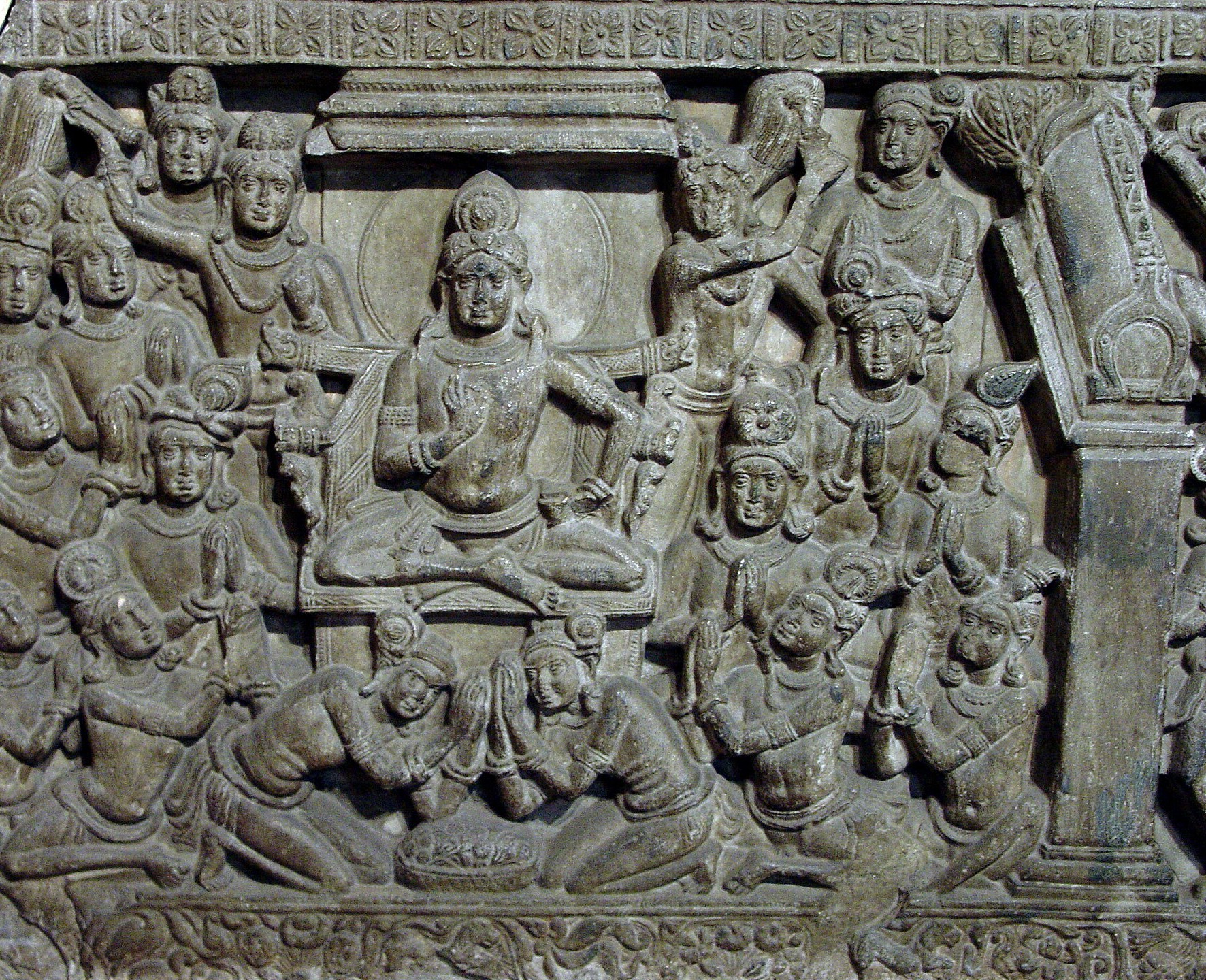
On a certain day, the Bodhisatta desired to go into the park. He called his charioteer, and said, “Yoke the chariot.” “Very good,” he replied, and adorning a great and most excellent chariot with all adornments, yoked the four royal Sindh horses of the colour of white lotus-petals, and informed the Bodhisatta. The Bodhisatta ascended the chariot, which was like a throne of the gods, and went towards the park. The gods thought, “The time for the enlightenment of prince Siddhattha is near, we will show him a previous sign,” and they caused a son of the gods to appear, infirm with age, broken-toothed, grey-haired, bent, with crooked body, leaning on a staff, trembling, and showed him. But only the Bodhisatta and the charioteer saw him. Then the Bodhisatta asked the charioteer in the way recorded in the Mahāpadāna discourse, “Friend, who is that man, even his hair is not like that of others?” And on hearing his reply said, “Woe upon birth, since through it old age must come to those who are born,” and with troubled heart he returned from thence and entered the palace. The king asked, “Why does my son return so quickly?” They said, “Your Majesty, he has seen an old man, and he is going to retire from the world.” “Why will you kill me? Prepare stage-plays for my son quickly; if he obtains happiness, he will not think of retiring from the world,” said the king. And he prepared a guard and set them in all directions to the distance of half a league.
Again on a certain day, as the Bodhisatta was going to the park, he saw a diseased man set there by the gods, and having asked in the same way he returned with troubled heart and entered the palace. The king also inquired as before said and again prepared a guard and put them on all sides to the distance of three-quarters of a league. Again another day when going to the park he saw a dead body put there by the gods and having asked in the same way he returned again with troubled heart to the palace. The king also inquired as before said and again prepared a guard and put them on all sides to the distance of a league. Again another day when going to the park he saw put there by the gods a hermit carefully and duly dressed. “Friend, who is this?” he asked the charioteer. As it was not the time of the appearance of a Buddha, the charioteer knew nothing of a hermit or the virtues of a hermit, but through the power of the gods he replied, “Your Highness, this is a hermit,” and described a hermit’s virtues. The Bodhisatta was delighted with the thought of renunciation, and that day he went on through the park. But the reciters of the Dīgha (Collection of long discourses) say that he went and saw the four signs all on one day.
Blog
This section provides an overview of the blog, showcasing a variety of articles, insights, and resources to inform and inspire readers.
-

Venus – Star of the Mayan’s
The Mayan people of Mesoamerica where avid star gazers who strived to understand the cosmos…
-
Human-Headed Winged Bull (Lamassu)
Assyrian ca. 883–859 BCE From the ninth to the seventh century B.C., the kings of…
-
Devi Bhagavata Purana – Chapter 11: The Birth of Budha
The Rishis said: “O Sūta! Who is that King Pururavā? and who is the Deva…