

On every occasion, Chinese lay stress on the age of their culture, and for good reasons. As a very advanced civilization, China was probably not the earliest one, but the only one of the ancient cultures that has survived until today: “5000 years of history, and 7000 years of culture” (wuqian nian de lishi, qiqian nian de wenhu). History clearly is not that old. The oldest traces of history (as a cultural stage that makes use of a script – see Chinese script) can be found in the 13th century BCE. Stories of older events and people cannot be proved by archaeology, but some little truth might be behind the tales that cover the time up to the “manufacturers” of the world. Although there is no myth (shenhua) of a god having created the universe like in many cultures, there numerous popular tales of persons that helped to build up and to repair the world during a time of chaos and uncertainty.
The mythological persons acting in such myths are by no means godlike but are rather part of the world they helped to construct. The most famous of these persons is Pan Gu, but there are also figures of lesser importance, like Nü Wa and her brother (and/or husband) Fu Xi who jointly repaired the world with dividers and ruler; or the heroical archer Lord Yi, who shut down eight of the nine existing suns to prevent the soil from burning out. There is also a large number of inventors like Sui Ren, who first used the fire; Hou Ji, the “Lord of Millet”, and Shen Nong, the “Divine Husbandman” – persons that introduced agriculture and the use of medical herbs; Chi You, the inventor of metallurgy and weapons or warfare; Bo Yi, who first tamed domestic animals; Can Cong, the inventor of sericulture in the state of Shu; or minister Cang Jie, who invented writing, and minister Ling Lun, who invented music and the pitch-pipes for musical tuning.
Nü Wa is said to have invented matrimony, and she shaped the first men of clay. A great part of Chinese mythology has its origin in the southern kingdoms of Chu, Wu and Yue. Here, in the water-rich regions of the Yangtze area, the prevention of inundations was a crucial task for the survival of communities. It was here that myths of the water-controllers Gun, Gong-Gong, Yu the Great (Da Yu), and Shun found their origin. Tales of these heroes are also the first that appear in Chinese literature, for example in the “Poetry of the South” (Chuci, especially the poem Tianwen “Asking Heaven”). In the oldest books of the Western Zhou period (11th cent.-770 BCE), the Shangshu “Book of Documents” and Shijing “Book of Songs”, it is only stated that the dynasties Xia and Zhou came from the west, and the Shang from the east. The people of the Zhou (Ji family) intermarried with people from the Jiang family, other families in prehistoric times were the Sanmiao barbarians in the south and the Zhongli or Chongli family.
Many tales and myths were only written down or were invented in early imperial times (from 2nd cent. BC), like the myth of the River God (He Shen) Ju Ling (Juling), who was annually offered a virgin; or the Goddess of River Xiang (Xiang Jun), venerated in what is today, Hunan; the Queen Mother of the West (Xiwangmu), who was believed to reside in the western paradise on Mount Kunlun. Other immortals are thought to live or have lived in the island paradise of Penglai in the Eastern Sea. The tales of the Yellow Emperor (Huang Di), Tai Hao (Fu Xi), Shao Hao (Zhi), Zhuan Xu (also called Gao Yang), Di Ku (also called Gao Xin), the holy and virtuous rulers Yao and Shun, and the founder of the Xia Dynasty, Yu the Great, who tamed the floods, divided the empire into the nine provinces (jiuzhou) and characterized the soil of every province, all these persons only became prominent subjects of mythology during the Spring and Autumn period (770-5th cent. BC).
The origin of these stories must be traced to tales of mythological rulers, gods or tribal ancestors of prehistoric tribes or families (zu) like the Ji, Si, Jiang (Qiang), Mi, Miao, or Ying. Many of these names are written with the radical “wife” (like the word for surname, xing), expressing the possible cognatic character of the ancient tribal groups. Tribal heroes or mythological tribal ancestors (zongshen) of different tribes and periods later merged to a unified pantheon of ancestor deities that became relatives of each other within a constructed lineage, with the Yellow Emperor at its head. The result of this unified pantheon can first be seen in the book Shanhaijing “Classic of the Mountain and Seas”, a bizarre pseudo-geography. The classification of the saints and rulers of highest antiquity, with “Three Augusts” and “Five Emperors” (San Huang Wu Di), took only shape during the Warring States (5th cent-220 BC) and Han (206 BC-220 AD) periods.
It was especially the Confucianists which stressed the virtuous character of Yao, Shun, and Yu the Great, and regarded them as morally exemplary rulers of the antiquity. These divine rulers were collectively called the “Two Emperors and Three Kings” (Er Di San Wang: Yao, Shun, Yu the Great – founder of the Xia dynasty, Tang the Perfect – founder of the Shang dynasty, and King Wen, founder of the Zhou dynasty). Apart from these “great” dynastic founders, the different books of the Warring States period mention dozens of deities and mythological rulers whose names later disappeared and were meaningless in contrast to this Confucian pentade. It was especially in the late Warring States period, when new deities came up that were projected into the time before the Yellow Emperor, gods like Sui Ren, Fu Xi, Nü Wa, and Shen Nong. Other deities like Tai Hao, Shao Hao and Yan Di disappeared.
The story of Pan Gu in Chinese mythology remains the essencial theme among Chinese people even today!
DIANA PRINCE
Huang Di (the Yellow Emperor), Yan Di (the Red Emperor), Bo Yi, Gong-Gong, Gun, Yu the Great. The Four Sacred Mountains (Siyue), Hou Ji, Gao Yu, Tai Wang, Xuan Ao, Jiao Ji, Chang Yi, Qing Yang, Di Hong and Jin Yun are associated with the west. Tai Hao, Shao Hao, Zhuan Xu, Di Ku, Yao, Yi, Zhuo, Jiao, Jun (i.e. Shun), Xie, Ming, Jin Tian and Lie Shan were associated with the east. (Note: There are 24 mountains in this list, not four as stated)
Several of these deities were also associated with astronomical constellations or with the colors corresponding to the Five Agents (wuxing), like the Yellow Emperor, the White Emperor (Baidi, i.e. Zhi), the Blue-Green Emperor (Qing Di, Cang Di, i.e. Fu Xi), the Black Emperor (Hei Di, i.e. Zhuan Xu), and the Red Emperor (Chi Di, i.e. Yan Di). Criticism of these mythologies came up during the Tang (618-907) and Song (960-1279) periods, but it was especially from the late 19th century on, that scholars like Kang Youwei (1858-1927), Xia Zengyou (1863-1924), Miao Fenglin (1899-1959) and Gu Jiegang (1893-1980) began to analyze the creation of these old myths and detected that they were composed of different local tales or myths of tribal ancestors and that thepantheon of these “deities” had taken shape during the late Warring States and the Han periods.
Fu Sinian (1896-1950), Meng Wentong (1894-1968), Yang Kuan (1914-2005) and Xu Xusheng (1888-1976) constated that the mythological tales originated from three cultural spheres: Hua (Zou-Lu, Dongyi) in the east, Xia (Jin, Huaxia) in the west, and the barbarian tribes (Miao 苗, Man, Chu) in the south. In the 1930s and 1940s a group of historians tried to derive social structures (idealiter: the primary communist society, yuanshi shehui) on the background of these traditional myths and tales.
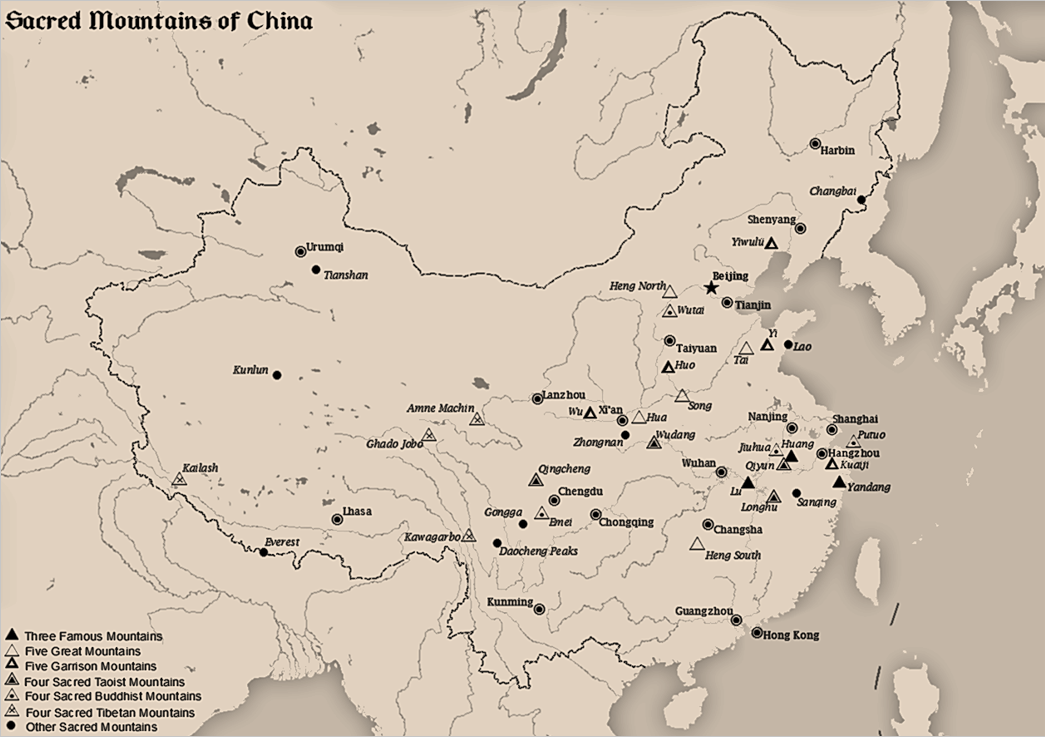
The Sacred Mountains of China are divided into several groups. The Five Great Mountains refers to five of the most renowned mountains in Chinese history, which have been the subjects of imperial pilgrimage by emperors throughout ages. They are associated with the supreme God of Heaven and the five main cosmic deities of traditional Chinese religion. The group associated with Buddhism is referred to as the Four Sacred Mountains of Buddhism; Sì dà fójiào míngshān), and the group associated with Taoism is referred to as the Four Sacred Mountains of Taoism; (Sì dà dàojiào míngshān). The sacred mountains have all been important destinations for pilgrimage, the Chinese term for pilgrimage (cháoshèng) being a shortened version of an expression which means “paying respect to a holy mountain” (cháobài shèng shān).
