

Sacred Mountains in China
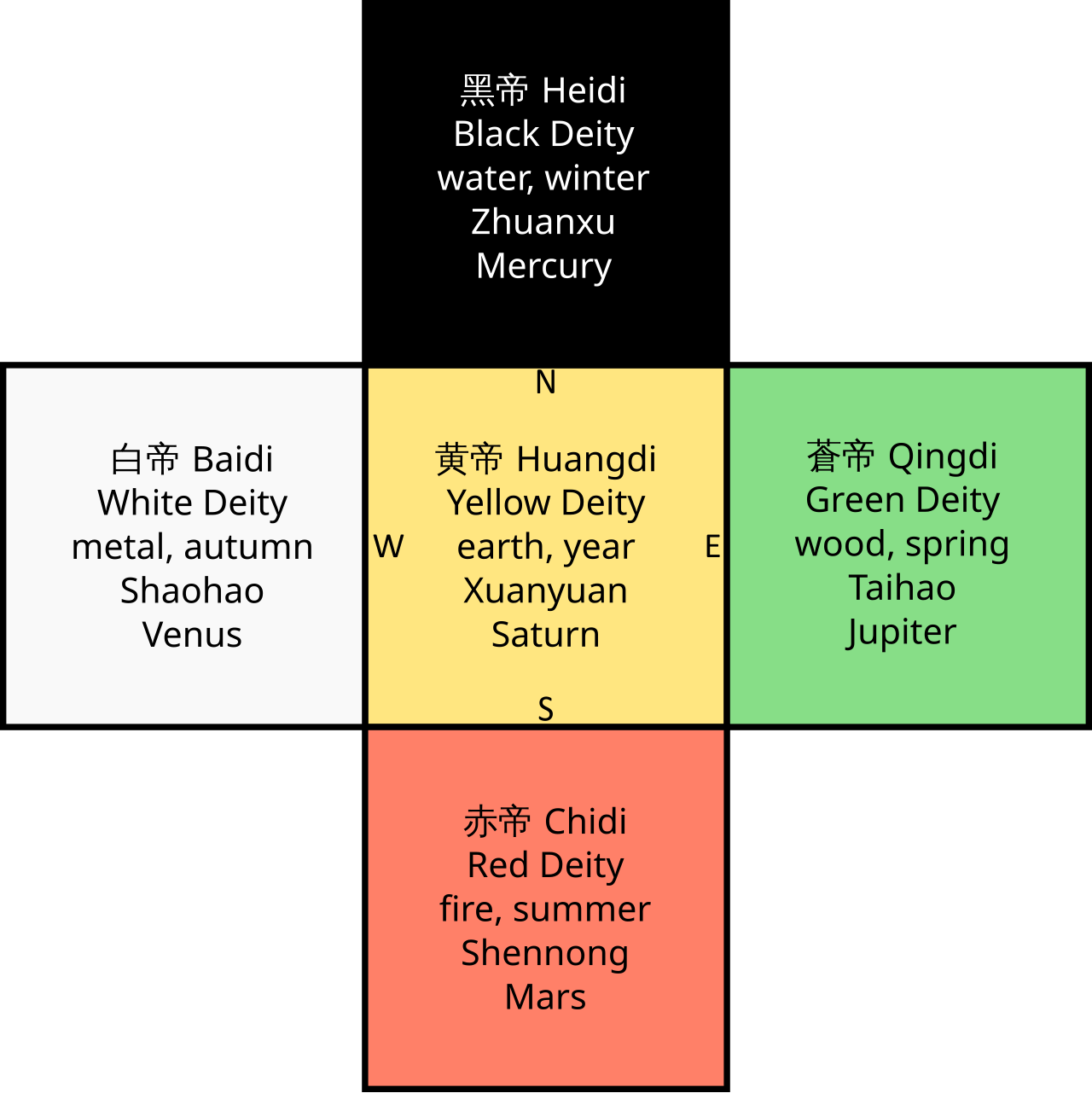
The five elements, cosmic deities, historical incarnations, chthonic and dragon gods, and planets, associated to the five sacred mountains. This Chinese religious cosmology shows the Yellow Emperor, god of the earth and the year, as the centre of the cosmos, and the four gods of the directions and the seasons as his emanations. The diagram is based on the Huainanzi. The Five Great Mountains are arranged according to the five cardinal directions of Chinese geomancy, which includes the center as a direction. The grouping of the five mountains appeared during the Warring States period (475–221 BC), and the term Wuyue (“Five Summits”) was made popular during the reign of the Wu Emperor of the Han dynasty (140–87 BC). In Chinese traditional religion they have cosmological and theological significance as the representation, on the physical plane of earth, of the ordered world emanating from the God of Heaven (Shangdi or Tian), inscribing the Chinese territory as an altar (tán), equivalent to the Indo-Buddhist mandala. The five mountains are among the best-known natural landmarks in Chinese history and, since the early periods in Chinese history, they have been the ritual sites of imperial worship and sacrifice.
In Chinese legend, the first sovereigns and emperors of China went on excursions or formed processions to the summits of the Five Great Mountains. Every visit took place at the same time of the year. The excursions were hunting trips and ended in ritual offerings to the reigning god. Historical emperors, starting with the First Emperor of the Qin, formalized these expeditions and incorporated them into state ritual. With every new dynasty, the new emperor hurried to the Five Great Mountains in order to lay claim to his newly acquired domains. Despite unavoidable interruptions, this imperial custom was preserved until the end of the last dynasty, when, after the fall of the Qing dynasty in 1911, Yuan Shikai had himself crowned as emperor at the Temple of Heaven in Beijing. But just to be safe, he also made an offer to the god of the northern Mount Heng. Since the year 2000, formal sacrifices both in Confucian and Taoist styles have been resumed.
The Five Great Mountains have become places of pilgrimage where hundreds of pilgrims gather in temples and caves. Although the Five Great Mountains are not traditionally canonized as having any exclusive religious affiliations, many of them have a strong Taoist presence, thus the five mountains are also grouped by some as part of the “Sacred Taoist Mountains”. There are also various Buddhist temples and Confucian academies built on these mountains. Alternatively, these mountains are sometimes referred to by the respective directions: the “Northern Great Mountain” (Běi Yuè), “Southern Great Mountain”; (Nán Yuè), “Eastern Great Mountain” (Dōng Yuè), “Western Great Mountain” (Xī Yuè), and “Central Great Mountain” (Zhōng Yuè). According to Chinese mythology, the Five Great Mountains originated from the body of Pangu, the first being and the creator of the world. Because of its eastern location, Mount Tai is associated with the rising sun which signifies birth and renewal.
Due to this interpretation, it is often regarded as the most sacred of the mountains. In accordance with its special position, Mount Tai has been considered to have been formed out of Pangu’s head. Mount Heng in Hunan from his right arm, Mount Heng in Shanxi from his left arm, Mount Song from his belly, and Mount Hua from his feet. In ancient times mountains were places of authority and fear, ruled by dark forces and faithfully worshipped. One reason for such worship was the value of the mountains to human existence as a spring of welfare and fertility, as the birthplace of rivers, as a place where herbs and medicinal plants grew and as a source of materials to build houses and tools. A basic element of Taoist thought was, and still is, an intuitive feeling of connectedness with nature. As early as the fourth century, the Taoists presented the high priests with the 180 precepts of Lord Lao for how to live a good and honest life.
Twenty of these precepts focused explicitly on the conservation of nature, while many other precepts were indirectly aimed at preventing the destruction of nature. Respect for nature has been a key component of Taoism from the very outset and, in its own right, explains why the Five Great Mountains are considered sacred. In addition, Taoists consider mountains as a means of communication between heaven and earth and as the place where immortality can be found. The sanctity of the Five Great Mountains is the reason why even today these mountains still host an exceptional diversity of plants, trees and animal species.
Eastern Mountain: Mount Tai: “Grand” or “Exalted Mountain” Shandong, 1,545 m. This mountain is associated with Feng Shan and by extension the Mandate of Heaven and life or death, being the most important of all the mountains.
Western Mountain: Mount Hua: “Splendid Mountain”, Shaanxi, 2,154 m
Southern Mountain: Mount Heng (Hunan): “Balancing” or “Balanced Mountain”, Hunan, 1,290 m
Northern Mountain: Mount Heng (Shanxi): “Permanent Mountain”, Shanxi, 2,017 m
In the course of history, there had been more than one location with the designation for Mount Heng, the North Great Mountain. The Great Northern Mountain was designated on the original Mount Heng with the main peak known as Mount Damao today, located at the intersection of present-day Fuping County, Laiyuan County and Tang County in Hebei province. Mount Heng was renamed Mount Chang to avoid the taboo of sharing the same personal name as Emperor Wen of Han. The appellations Heng and Chang were used extensively in the past to name various districts in the region, such as Changshan Prefecture, Hengshan Prefecture, and Hengzhou. While it was customary of the ethnic Han emperors to order rites to be performed regularly to honour the Five Great Mountains, the location of the original Mount Heng meant that for much of the eras of fragmentation, the region was either under non-Han rulers or a contested area.
The shrines built to perform the rites were neglected and damaged from time and natural disasters. The decline was especially acute after the overthrow of the Yuan dynasty when the local population fell sharply after the wars. This created opportunities for Ming dynasty officials who were natives of Shanxi to spread rumours that the spirit of Mount Heng had abandoned the original location and settled on Xuanwu Mountain in Hunyuan County in Shanxi. Between the reigns of Emperor Hongzhi and Emperor Wanli, they kept petitioning the emperors to declare the change and decree for the rites for the Northern Great Mountain to be shifted there. In 1586, Emperor Wanli opted a compromise by re-designating the Xuanwu Mountain as Mount Heng but ordered the relevant rites to continue to be performed in the historic Beiyue Temple. The movement for the change persisted after the demise of the Ming dynasty and rise of the Qing. Finally, Emperor Shunzhi consented to have the rites to be moved to Shanxi as well.
